I last blogged about handling routes in a Laravel and Inertia app. The premise was that we don’t have access to Laravel’s URL generator functions with Inertia, so we need to pass our application’s routes down differently.
The same problem exists with authorization: we don’t have access to the can helper and other Gate methods. Here’s a short post about dealing with authorization on the frontend.
Read more
Back in 2003 when I was still in elementary school, Dave Akins wrote a list of laws to abide when building a spacecraft. I’m not planning to build one of those any time soon, but there seem to be many similarities with web development. A few examples:
- Engineering is done with numbers. Analysis without numbers is only an opinion
- Design is based on requirements. There’s no justification for designing something one bit “better” than the requirements dictate
- Don’t do nuthin’ dumb
Here’s a good one te keep next to your desk, and consider yourself lucky next time you ship a bug to production.
- Space is a completely unforgiving environment. If you screw up the engineering, somebody dies
Read all 44 laws at their home on spacecraft.ssl.umd.edu.
I work at an agency that started out building websites and small apps, but the past years have shifted towards larger web apps and products.
Small projects are easy to manage. GitHub issues or Basecamp todos are more than enough to keep things going. Adding a feature or refactoring a small project is also easy, because there aren’t too many moving parts to take consider.
Large and especially long-living projects are constant moving targets. It’s harder to estimate things and technical debt can become a real issue. A linear, chronological task list won’t do it anymore, we need to start prioritizing things.
I want to share four systems that have helped me, both on a personal and team level, prioritize work on large projects.
Read more
This was originally a lightning talk at Full Stack Europe 2019. You can watch the video on their YouTube channel.
In the 4.5 years I’ve been a developer at Spatie, over 200 packages have been built and released by our team. I’ve done quite some authoring and maintenance over the years, and I’d like to share 8 actionable tips on writing and maintaining open source software without going insane.
Read more
I was lucky enough to see Jeremy Keith speak at the inaugural edition of Full Stack Europe. He did a keynote on building on/for the web. I’m not going to distill the talk’s content to a few paragraphs as that wouldn’t do it justice, hopefully the talk will come online at some point.
One thing I’d like to mention he talked about is the difference between materials and tools for the web. Jeremy written about this in the past, and I believe his journal entry is an article worth sharing.
On the one hand, you’ve got the raw materials of the web: HTML, CSS, and JavaScript. This is what users will ultimately interact with.
On the other hand, you’ve got all the tools and technologies that help you produce the HTML, CSS, and JavaScript: pre-processors, post-processors, transpilers, bundlers, and other build tools.
And a bit further:
I have opinions on the quality of the materials that get served up to users; the output should be accessible and performant. But I don’t particularly care about the tools that produced those materials on the back of the front end. Use whatever works for you (or whatever works for your team).
Read the full article on adactio.com.
Today I tagged v1 of a new package: Laravel Mix Preload. It automatically generates preload and prefetch links based on the contents of your mix-manifest.json file.
Read more
Want to view a single image on @imgur (literally its only job)? Good luck! You gotta successfully download (354KB) and run (1.21MB) of client-side React in order to get your image requested as resource 110 of 553. What should have been an IMG element became… this.
@csswizardry - and don’t forget to look at the visualization
This is ridiculous. Things like this don’t even make me any mad anymore, they disappoint.
To make things worse, a large portion of the replies try to justify everything with “but business decisions…”.
Nah.
We can do better. We should do better.
Takuya’s is the sole developer and owner of Inkdrop, a popular markdown app. He wrote setting goals to make his product better instead of bigger.
I asked myself “do I really need another goal?” Because the project is just what I love to do in the first place, as I wrote in the article about grit. Making it profitable was merely a requirement to continue doing it and not a genuine source of the motivation.
I’ve been thinking about the balance between growth and sustainability lately, and this quote from the article stuck out:
By focusing not on endless growth or expansion, it makes your business sustainable. Interestingly, about 90 percent of all businesses worldwide that are more than 100 years old are Japanese. They all have fewer than 300 employees, and the ones that still exist never grow quickly or without great reason.
Read the full article on blog.inkdrop.info.
I built a small React component that uses the Google Places API to autocomplete an address in a project I’m working on, and extracted the prediction fetching to a custom useAddressPredictions hook. It’s a nice example of a custom React hook composed of different primisite hooks, so I decided to pen write my thought process while building it.
Read more
I prefer to use light interfaces, so I rarely use dark mode in macOS or iOS. I often see people add dark mode to their sites, but never really knew whether visitors actually care. I started a Twitter poll:
Do you consider dark mode on websites / blogs (not apps) useful?
The poll is still open. At the time of writing, 225 people responded, and 47% answered “Yes”. Enough to convince me to add a dark mode to my blog.
Read more
React follows semantic versioning, but with a twist. From their versioning policy:
When releasing critical bug fixes, we make a patch release by changing the z number (ex: 15.6.2 to 15.6.3).
When releasing new features or non-critical fixes, we make a minor release by changing the y number (ex: 15.6.2 to 15.7.0).
When releasing breaking changes, we make a major release by changing the x number (ex: 15.6.2 to 16.0.0).
The twist is subtle: non-critical bugfixes are released as minor releases.
I’ve often wondered whether three digits really is necessary for versioning. As a package maintainer, deciding between minor and patch is often a gray area.
Two digits would suffice: breaking changes and non-breaking changes. Feature or bugfix doesn’t really matter from a technical point of view: upgrading can either break things, or can’t.
React reserves the patch number for critical bugfixes, which I believe is a necessary escape hatch in a two digit system. But I like I how they default to simply bumping minor versions.
Last week I published a post about how I implemented live updates on an Oh Dear! status page.
Caleb Porzio rebuilt the page with Livewire. It’s pretty impressive to see how easy the process is by just adding a few built in Livewire directives.
Watch the short screencast on Caleb’s blog.
Both Inertia.js and Livewire have been in the spotlight the past few months. The two libraries often get put next to each other because of their (coincidentally) simultaneous releases.
I’ve seen many people compare the two, or ask if they can be used together. This post showcases their similarities and differences, and should help you understand which problems they each solve best.
Read more
If you’re building an app with Laravel and Inertia, you don’t have access to Laravel’s helper methods because you’re writing views in JavaScript. This means you lose the ability to generate URLs on the fly with Laravel’s route and action helpers.
This short post outlines two ways to deal with routes in a Laravel and Inertia app.
Read more
Last week Oh Dear! launched a new status pages feature. I designed them and implemented their frontend. Here’s a live example on status.flareapp.io.
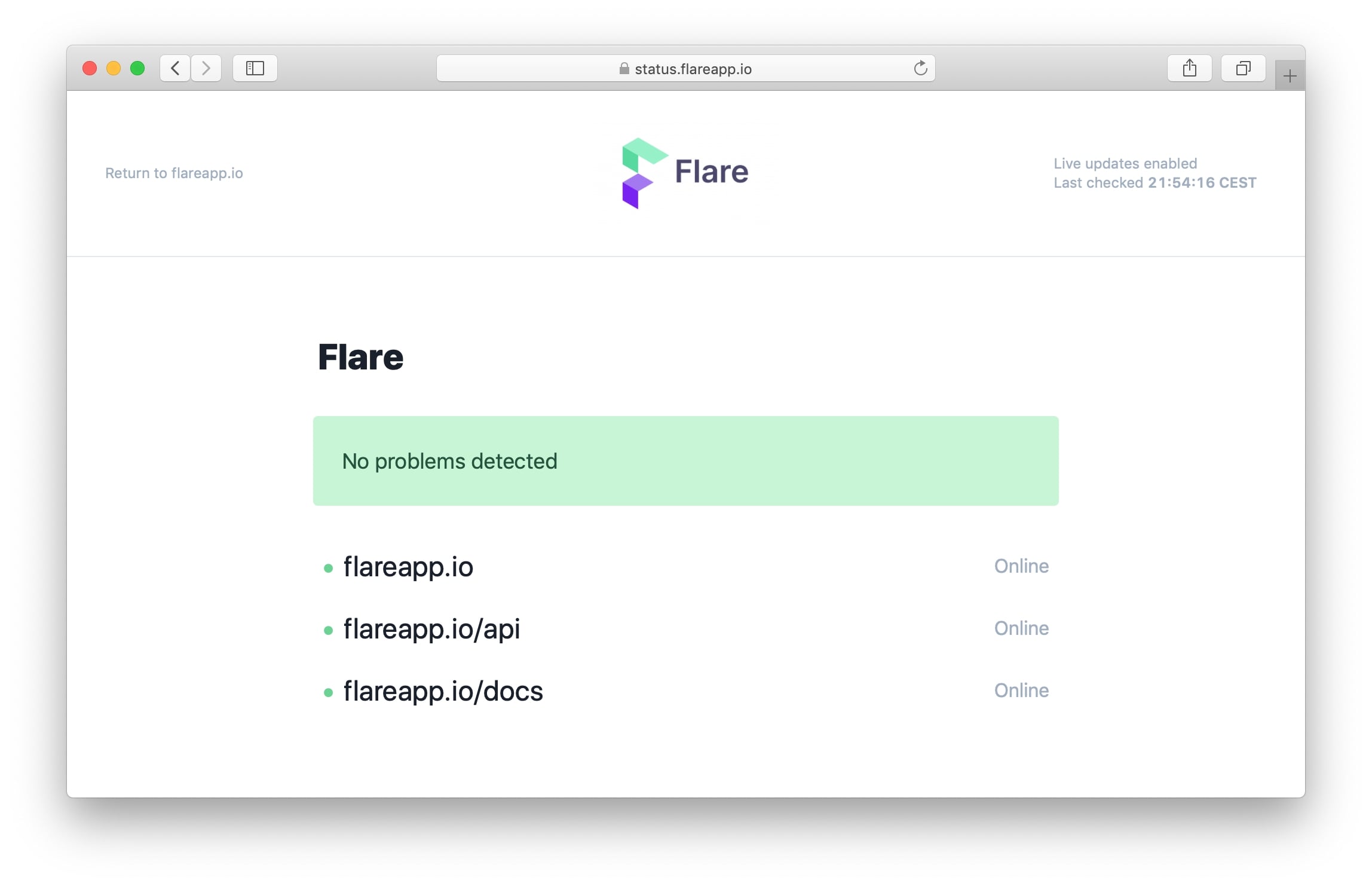
We were originally going to use Vue for the pages, so we could make the entire view reactive so we could easily fetch and update data with AJAX or websockets. I started building the status page view, but quickly became hesitant about the decision to use Vue. It didn’t feel like the right tool for the job.
Read more